DIY Move vs. Hiring Movers: An Honest Cost and Sanity Breakdown
A real cost comparison between DIY moving and hiring professionals. Includes hidden costs like injury risk, relationship strain, and the hybrid approach most people miss.
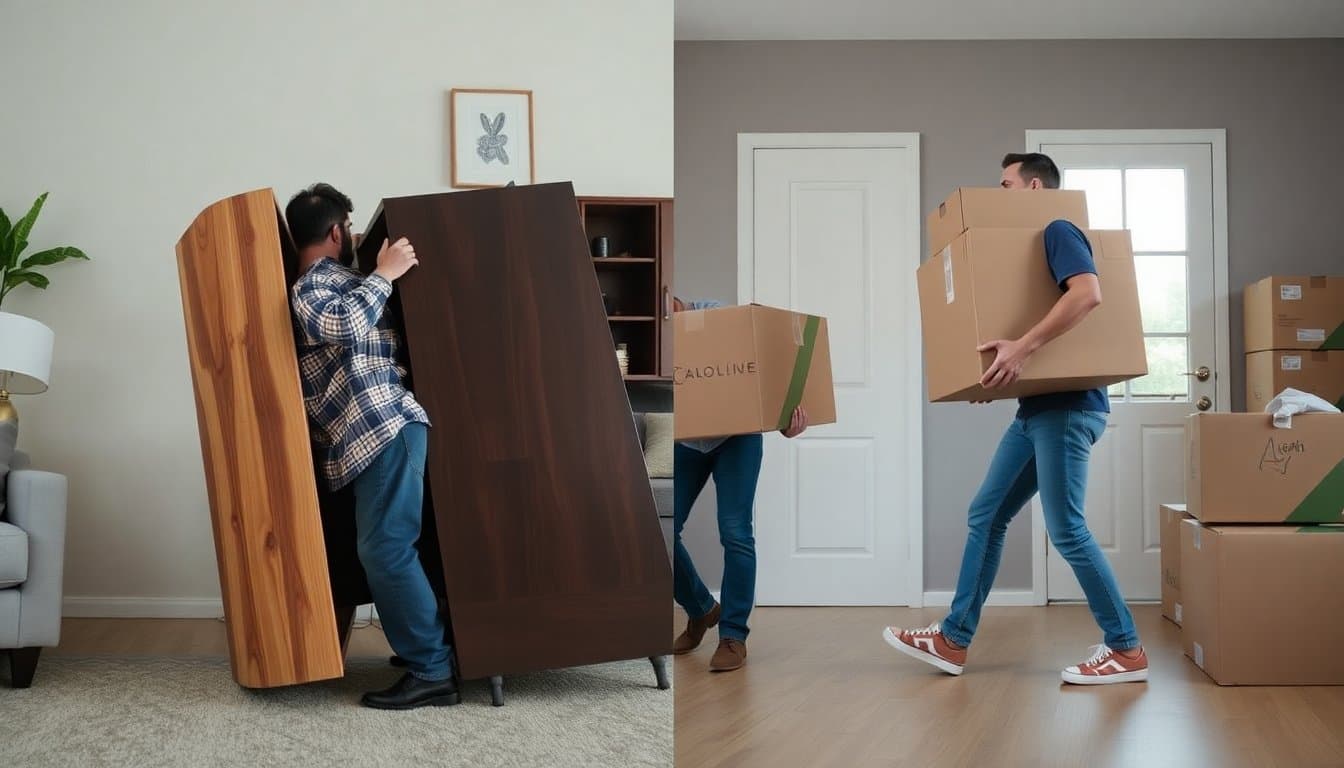
Key Takeaways
- A DIY local move costs $200 to $500. Hiring movers costs $800 to $2,500. The price gap is real, but so are the hidden costs of doing it yourself.
- Hire movers for anything over a 1-bedroom unless you're under 30 and have strong friends. That's not a joke. Back injuries from moving furniture are one of the most common reasons for ER visits during relocations.
- The hybrid approach saves money and your body. Pack everything yourself, hire movers just for the heavy stuff (furniture, appliances). You'll save 30 to 40% off a full-service move.
- Factor in your time. A DIY move takes a full day minimum. If you earn $40/hour and spend 10 hours moving, that's $400 in opportunity cost you're not counting.
I've seen both sides of this. I've watched people save $1,500 by renting a truck and calling in favors. I've also watched people throw out their back lifting a dresser, scratch hardwood floors dragging a couch, and not speak to their best friend for two months after a move that went sideways. The money math is only part of the equation.
What does a DIY move actually cost?
A DIY local move runs $200 to $500 for truck rental, gas, insurance, and supplies. A long-distance DIY move jumps to $1,000 to $3,000 depending on distance. These numbers don't include the cost of your time or the pizza and beer for your friends.
Let me break it down for a typical local move (2-bedroom apartment, 15 miles):
| Expense | Cost Range |
|---|---|
| Truck rental (1 day) | $30 - $150 |
| Gas | $50 - $100 |
| Rental insurance | $15 - $50 |
| Furniture pads/dollies | $20 - $50 |
| Moving supplies (tape, wrap) | $30 - $60 |
| Food and drinks for helpers | $50 - $100 |
| Total | $195 - $510 |
Looks cheap. And it can be, if nothing goes wrong.
But here's what the spreadsheet doesn't capture: your full day is gone. You spent the previous evening loading, you're sore, your helpers showed up two hours late (one didn't show at all), and you still need to return the truck by 6 PM or pay for another day.
What do professional movers cost?
Local movers charge $80 to $150 per hour with a 2 to 3 hour minimum. A 2-bedroom local move typically runs $800 to $2,500. Long-distance moves jump to $3,000 to $7,000 depending on distance and weight.
For a local move, most companies send a 2 or 3-person crew. Here's what to expect:
- Studio/1-bedroom: $400 - $800 (2-3 hours)
- 2-bedroom: $800 - $1,500 (4-6 hours)
- 3-bedroom house: $1,200 - $2,500 (6-8 hours)
- 4+ bedroom house: $2,000 - $4,000 (8+ hours)
Long-distance pricing is based on weight and distance, not hours. A 2-bedroom apartment moving 1,000 miles averages $4,000 to $5,500. Cross-country (2,500+ miles) can hit $7,000 to $10,000.
Get at least three quotes. Any company that gives a binding estimate without seeing your stuff (in person or via video walkthrough) is guessing, and lowball estimates that double on delivery day are one of the most common moving day problems.
What hidden costs does nobody mention?
The real cost of a DIY move includes injury risk, property damage, relationship strain, and time. These don't show up on a receipt, but they're real, and I've seen every one of them happen.
Injury risk. Back injuries from lifting heavy furniture are shockingly common. A queen mattress weighs 60 to 100 pounds. A full-size refrigerator weighs 200 to 300 pounds. A sectional sofa can hit 250 pounds. Professional movers do this every day and have the equipment (dollies, straps, ramps) and technique to move heavy items safely. Your college roommate does not.
Property damage. Scratched hardwood floors, dinged door frames, chipped walls, and broken banisters. When you're wrestling a dresser down a narrow staircase, something's getting damaged. Professional movers carry liability insurance. If they damage your floor, they pay for it. If your buddy damages your floor, you're buying him a beer and eating the repair cost.
Relationship strain. This is the one people laugh about until it happens. Asking friends to spend their Saturday carrying your stuff down three flights of stairs is a big ask. If the day runs long, if it's hot, if someone gets hurt, if you're stressed and snapping at people, friendships take a hit. I've seen it happen more times than I can count.
Time cost. A professional crew moves a 2-bedroom apartment in 4 to 6 hours. A DIY move with friends takes 8 to 12 hours for the same amount of stuff, sometimes longer. If you value your time at $30 to $50/hour, those extra hours add up fast.
When should you definitely hire movers?
Hire movers if you have heavy furniture, multiple flights of stairs, a tight timeline, fragile or valuable items, or a household larger than a 1-bedroom apartment. The cost difference shrinks when you account for risk and time.
My rule: hire movers for anything over a 1-bedroom unless you're under 30 and have strong friends who genuinely want to help (not friends who said yes because they felt obligated).
Specific situations where movers are worth every dollar:
- You have a piano, pool table, or safe
- Third floor or higher with no elevator
- Move-out and move-in must happen the same day
- You have antiques, art, or items worth more than the cost of movers
- You or your partner has a back, knee, or shoulder issue
- You have young kids who need supervision while everything is happening
What's the hybrid approach?
Pack everything yourself and hire movers only for the heavy lifting: furniture, appliances, and mattresses. This cuts your moving bill by 30 to 40% and keeps your body intact.
This is what I recommend for most people. Full-service moves (where movers pack and unpack everything) are expensive: $3,000 to $5,000 for a local 3-bedroom. But you don't need to pay someone to wrap your dishes. You can do that.
The hybrid breakdown:
- You handle: Packing all boxes and totes, labeling, loading small items into your car, cleaning, organizing
- Movers handle: Couch, beds, dressers, dining table, washer/dryer, refrigerator, anything over 50 pounds
This approach typically saves $800 to $1,500 on a local move. You get the cost savings of DIY where it's easy (packing) and the safety of professionals where it matters (heavy lifting).
When you're packing yourself, using sturdy reusable totes instead of cardboard makes the process faster and protects your stuff better. Check our totes vs. cardboard comparison for the full breakdown.
How much should you tip movers?
Tip $20 to $30 per mover for a standard move, $40 to $50 per mover for a long, difficult, or multi-flight move. Cash, handed directly to each person at the end of the job.
Tipping isn't required, but movers work hard. A 3-person crew that moved your 2-bedroom apartment in 4 hours carried roughly 5,000 to 8,000 pounds of your belongings. A $20 to $30 tip per person is standard. If they handled stairs, rain, tight parking, or an unusually heavy load, bump it up.
Don't tip as a percentage of the bill. $50 per mover on a $5,000 long-distance move is generous. $500 per mover (10%) would be excessive.
Also: offer water and snacks. It costs you $10 and it makes a real difference in how your crew treats your stuff.
So which should you choose?
Do the math with honest numbers. Include your time, your risk tolerance, and the value of your furniture. For most households, the hybrid approach hits the sweet spot: affordable, safe, and done by dinner.
Here's the quick decision framework:
- Studio or small 1-bedroom, ground floor, local move: DIY is fine. Total cost: $200 to $400.
- 1 to 2-bedroom, some stairs, local move: Hybrid. Pack yourself, hire movers for furniture. Total cost: $500 to $1,200.
- 3+ bedroom house, any distance: Hire movers. Your time and your back are worth more than the savings. Total cost: $1,500 to $4,000 local.
- Any long-distance move: Hire movers. Driving a 26-foot truck across state lines is not a casual Saturday activity. Total cost: $3,000 to $7,000.
The cheapest move isn't always the best move. The best move is the one where nothing breaks, nobody gets hurt, and you're sleeping in a made bed by 9 PM.
FAQs
Is it cheaper to move yourself or hire movers? A DIY local move costs $200 to $500. Hiring movers costs $800 to $2,500 for the same move. DIY is cheaper on paper, but when you factor in time (8 to 12 hours), injury risk, and potential property damage, the gap narrows significantly. The hybrid approach (pack yourself, hire movers for heavy items) costs $500 to $1,200 and gives you the best of both.
How much do movers cost per hour? Local movers charge $80 to $150 per hour for a 2-person crew and $120 to $200 per hour for a 3-person crew. Most companies have a 2 to 3 hour minimum. A 2-bedroom local move typically takes 4 to 6 hours.
Should I tip movers and how much? Yes. Tip $20 to $30 per mover for a standard move and $40 to $50 per mover for a difficult one (stairs, long carry distances, extreme heat). Hand cash directly to each mover at the end of the job. Offering water and snacks during the move is also appreciated.
What's the biggest risk of a DIY move? Injury. Back strains and sprains from lifting heavy furniture are the most common issue. Professional movers have equipment (dollies, straps, ramps) and training to move heavy items safely. The second biggest risk is property damage: scratched floors, dented walls, and broken items that cost more to repair than the movers would have charged.
Keep Reading
Frequently Asked Questions
- Is it cheaper to move yourself or hire movers?
- A DIY local move costs $200 to $500. Hiring movers costs $800 to $2,500 for the same move. DIY is cheaper on paper, but when you factor in time (8 to 12 hours), injury risk, and potential property damage, the gap narrows significantly. The hybrid approach (pack yourself, hire movers for heavy items) costs $500 to $1,200 and gives you the best of both.
- How much do movers cost per hour?
- Local movers charge $80 to $150 per hour for a 2-person crew and $120 to $200 per hour for a 3-person crew. Most companies have a 2 to 3 hour minimum. A 2-bedroom local move typically takes 4 to 6 hours.
- Should I tip movers and how much?
- Yes. Tip $20 to $30 per mover for a standard move and $40 to $50 per mover for a difficult one (stairs, long carry distances, extreme heat). Hand cash directly to each mover at the end of the job. Offering water and snacks during the move is also appreciated.
- What's the biggest risk of a DIY move?
- Injury. Back strains and sprains from lifting heavy furniture are the most common issue. Professional movers have equipment (dollies, straps, ramps) and training to move heavy items safely. The second biggest risk is property damage: scratched floors, dented walls, and broken items that cost more to repair than the movers would have charged.